Italian Sign Language Manual Alphabet
The which is used in. Letters are shown from a variety of orientations.Fingerspelling (or dactylology) is the representation of the of a, and sometimes, using only the hands. These manual alphabets (also known as finger alphabets or hand alphabets), have often been used in, and have subsequently been adopted as a distinct part of a number of; there are about forty manual alphabets around the world. Historically, manual alphabets have had a number of additional applications—including use as, as, and in silent religious settings.
There are two families of manual alphabets used for representing the in the modern world. The more common of the two is mostly produced on one hand, and can be traced back to alphabetic signs used in Europe from at least the early 15th century. The alphabet, first described completely by Spanish monks, was adopted by the 's deaf school in Paris in the 18th century, and was then spread to deaf communities around the world in the 19th and 20th centuries via educators who had learned it in Paris. Over time, variations have emerged, brought about by natural that occur over time, adaptions for local written forms with special characters or (which are sometimes represented with the other hand), and avoidance of handshapes that are considered in some cultures. The most widely used modern descendant is the.
Two-handed Two-handed manual alphabets are used by a number of deaf communities; one such alphabet is shared by users of, and (collectively known as the language family), while another is used in. Some of the letters are represented by iconic shapes, and in the BANZSL languages the vowels are represented by pointing to the fingertips.Letters are formed by a dominant hand, which is on top of or alongside the other hand at the point of contact, and a subordinate hand, which uses either the same or a simpler handshape as the dominant hand. Either the left or right hand can be dominant. In a modified tactile form used by people, the signer's hand acts as the dominant hand, and the receiver's hand becomes the subordinate hand.Some signs, such as the sign commonly used for the letter C, may be one-handed.Other alphabets Manual alphabets based on the, the Ethiopian and the Korean script use handshapes that are more or less iconic representations of the characters in the writing system. Some manual representations of non-Roman scripts such as Chinese, Devanagari (e.g. The ), Hebrew, Greek, Thai and Russian alphabets are based to some extent on the one-handed Latin alphabet described above.
In some cases however, the 'basis' is more theory than practice. Thus, for example, in the only the five vowels (ア /a/, イ /i/, ウ /u/, エ /e/, オ /o/) and the Ca (consonant plus 'a' vowel) letters (カ /ka/, サ /sa/, ナ /na/, ハ /ha/, マ /ma/, ヤ /ya/, ラ /ra/, ワ /wa/, but notably not タ /ta/ which would resemble a somewhat rude gesture) derive from the. In the it is only four 'letters' which derive from the: अ /a/, ब /b/, म /m/, and र /r/).The represents characters from the as well as.Fingerspelling in sign languages Fingerspelling has been introduced into certain sign languages by educators, and as such has some structural properties that are unlike the visually motivated and multi-layered signs that are typical in deaf sign languages. In many ways fingerspelling serves as a bridge between the sign language and the oral language that surrounds it.Fingerspelling is used in different sign languages and for different purposes. It may be used to represent words from an oral language which have no sign equivalent, or for emphasis, clarification, or when teaching or learning a sign language.In (ASL), more lexical items are fingerspelled in casual conversation than in formal or narrative signing.
Different sign language use fingerspelling to a greater or lesser degree. At the high end of the scale, fingerspelling makes up about 8.7% of casual signing in ASL, and 10% of casual signing in. The proportion is higher in older signers, suggesting that the use of fingerspelling has diminished over time.
Across the, only 2.5% of the of was found to be fingerspelling. Fingerspelling has only become a part of NZSL since the 1980s; prior to that, words could be spelled or initialised by tracing letters in the air. Fingerspelling does not seem to be used much in the sign languages of Eastern Europe, except in schools, and is also said to use very little fingerspelling, and mainly for foreign words. Sign languages that make no use of fingerspelling at all include. AD 1494 illustration of a finger alphabet and counting system originally described by in 710 AD.
The is represented, with three additional letters making a total of 27, by the first three columns of numbers. The first two columns are produced on the left hand, and the next two columns on the right.
Modified the finger alphabet to the form shown above, where the handshapes for 1 and 10 on the left hand correspond to the 100s and 1000s on the right.The speed and clarity of fingerspelling also varies between different signing communities. In Italian Sign Language, fingerspelled words are relatively slow and clearly produced, whereas fingerspelling in standard (BSL) is often rapid so that the individual letters become difficult to distinguish, and the word is grasped from the overall hand movement. Most of the letters of the BSL alphabet are produced with two hands, but when one hand is occupied, the dominant hand may fingerspell onto an 'imaginary' subordinate hand, and the word can be recognised by the movement. As with written words, the first and last letters and the length of the word are the most significant factors for recognition.When people fluent in sign language read fingerspelling, they do not usually look at the signer's hand(s), but maintain eye contact and look at the face of the signer as is normal for sign language. People who are learning fingerspelling often find it impossible to understand it using just their and must look directly at the hand of someone who is fingerspelling. Often, they must also ask the signer to fingerspell slowly. It frequently takes years of expressive and receptive practice to become skilled with fingerspelling.History.
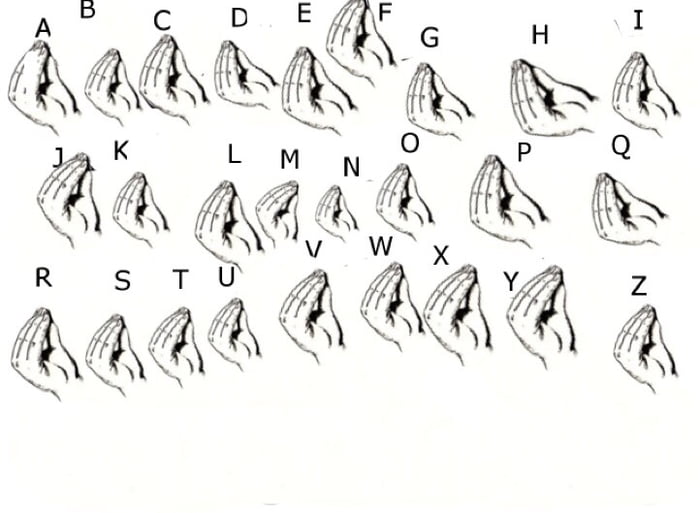
Italian Sign Language Dictionary
Alphabetic gestures have been discovered in hundreds of medieval and renaissance paintings. The above is from Fernando Gallego's retablo panels, 1480-1488, in.Some writers have suggested that the body and hands were used to represent alphabets in Greek, Roman, Egyptian and Assyrian antiquity. Certainly, ' systems were widespread, and capable of representing numbers up to 10,000; they are still in use today in parts of the Middle East.
The practice of substituting letters for numbers and vice versa, known as, was also common, and it is possible that the two practices were combined to produce a finger calculus alphabet. The earliest known manual alphabet, described by the monk in 8th century, did just that. While the usual purpose of the Latin and Greek finger alphabets described by Bede is unknown, they were unlikely to have been used by deaf people for communication — even though Bede lost his own hearing later in life. Historian Lois Bragg concludes that these alphabets were 'only a bookish game.' Beginning with in 1938, several writers have speculated that the 5th century Irish script, with its alphabet system, was derived from a finger alphabet that predates even Bede. Antique hand memory system, three variants. Simco electrostatic fieldmeter fmx-003 manual diagram. Originally published in 'Thesavrvs Artificiosae Memoriae', in Venice, 1579.European monks from at least the time of Bede have made use of forms of, including alphabetic gestures, for a number of reasons: communication among the monastery while observing, administering to the ill, and as devices.
They also may have been used as for discreet or secret communication. Clear antecedents of many of the manual alphabets in use today can be seen from the 16th century in books published by friars in Spain and Italy. From the same time, monks such as the Benedictine began tutoring deaf children of wealthy patrons — in some places, literacy was a requirement for legal recognition as an heir — and the manual alphabets found a new purpose. They were originally part of the earliest known Mouth Hand Systems.
Italian Body Language
The first book on deaf education, published in 1620 by in Madrid, included a detailed account of the use of a manual alphabet to teach deaf students to read and speak.
Manual alphabet is a set of manual alphabetical letters, corresponding to the written/spoken alphabet. It is used for fingerspelling a string of the alphabetical letters of a certain written/spoken word, person's name, etc.The two-handed British manual alphabet is commonly used in Australia, England, New Zealand and some other countries. Both British manual alphabet and British sign language are entirely different from the American manual alphabet and American Sign Language which are mainly used in the U.S.
New Articles
- Bamini To Unicode Converter
- Vmware Esxi 5 License Key Limitations Act
- W Labiryncie Serial Za Darmo
- Vmware Vcenter Server 5.1 Iso
- Grass Valley Canopus Edius 6.52 Crack
- Corel Draw For Windows Xp
- Ajaran Konfusianisme Pdf
- Sniper Elite V2 [r.g. Mechanics Setup.exe
- Descargar Juegos Pipo Gratis Espanol 1 Link
- Magnum 4d Prediction Chart
- Download Radimpex Tower 5 Crack
- Minecraft Kostenlos En Deutsch Vollversion Offline
- Camtasia Studio 7 Craccato Gratis
- Use Case For Hotel Reservation System
- Jackson Guitars Made In Japan Serial Numbers
- Realm Of Chaos Slaves To Darkness Pdf
- Aspiration Risk Screening Tool